Coming to This
We have done what we wanted.
We have discarded dreams, preferring the heavy industry
of each other, and we have welcomed grief
and called ruin the impossible habit to break.
And now we are here.
The dinner is ready and we cannot eat.
The meat sits in the white lake of its dish.
The wine waits.
Coming to this
has its rewards: nothing is promised, nothing is taken away.
We have no heart or saving grace,
no place to go, no reason to remain.
--- Mark Strand
Saturday, March 14, 2015

Sunday, March 01, 2015
Safar Mein Dhoop
Safar mein dhoop to hogi
Jo chal sako to chalo
Jo chal sako to chalo
Sabhi hai bhid mein tum bhi
Nikal sako to chalo
Nikal sako to chalo
Safar mein dhoop to hogi
Jo chal sako to chalo
Jo chal sako to chalo
Kisi ke waste rahe kaha badalti hai
Tum apne aap ko khud hi
Badal sako to chalo safar mein
Dhoop to hogi jo chal sako to chalo
Tum apne aap ko khud hi
Badal sako to chalo safar mein
Dhoop to hogi jo chal sako to chalo
Yaha uajalo ki kimat chukani padti hai
Tum apni aag mein suraj sajal sako to jalo
Safar mein dhoop to hogi
Jo chal sako to chalo
Tum apni aag mein suraj sajal sako to jalo
Safar mein dhoop to hogi
Jo chal sako to chalo
Yaha kisi ko koi rashta nahi deta
Mujhe girake agar tum
Sambhal sako to chalo
Mujhe girake agar tum
Sambhal sako to chalo
Sabhi hai bhid mein tum bhi
Nikal sako to chalo
Safar mein dhoop to hogi
Jo chal sako to chalo.
Safar mein dhoop to hogi
Jo chal sako to chalo.
Friday, January 30, 2015
American Sniper
American Sniper is the story of a U.S. Navy SEAL whose defining skill is his ability to hit targets, alive and inert, at a distance and through a scope. It is the story of Chris Kyle; an all-American boy who found his calling, post 9-11, in the invasion of Iraq, in the city of Fallujah.
The movie has been vilified as the work of the right-wing former movie star, Clint Eastwood. A man, it is assumed, with an agenda and who glorifies killing and holds up American nationalism. It has been seen as an apologia for American brashness, forgetfulness, imperialism, capitalism and martial culture.
The movie has some intelligent detractors: An excellent column written by Gary Younge for the guardian.com very ably parses the argument for the middle road. America's short recall of history, it's use of Guantanamo Bay even as it pointed out for half a century Cuba's slights against human rights, the immediate and reactionary call to arms against all comers after a terror attack, America's support of the human rights-stomping theocracy of Saudi Arabia are all (and rightly so) used to show how hypocritical the U.S. can be in it's relations with the world.
For me, the movie is a measure of true American stock: Middle American families, stoutly built with a work ethic to match, clever, inventive, adaptable -- God's people in the best sense of that phrase. Chris Kyle is perhaps not the best representative of this type, but I did once meet an American who did "represent."
I had the opportunity of spending four days in a Land Rover driving through the national parks of Tanzania: Ngorongoro, Olduvai Gorge, the Serengeti Plains and Lake Manyara with a retired American and his wife on holiday. I was in my late 30's and he was in his late 60's. It was a year after 9-11. He was ex-military, fond of hunting near his home in Oregon, kids in university and kind and attentive with his wife. While I strained to spot wildlife in the distance, this man, past his prime, would spot cheetahs and deer before the guide ever did. He told stories with aplomb and ignored tourist traps and touts without blinking an eye. He was, in my estimation, confident, accomplished, humble, and unabashedly proud to be an American but tempered by a need to learn about the world.
He is the kind of American I imagine meeting in small town America, or on a university campus; he is as easily found astride a combine as on a humvee. He is the best that America has been and still is in some ways. He reminds me a lot of Chris Kyle, the sniper.
American Sniper is not so much a jingoistic ode to America as it is a chance to reflect on the inhumanity of humanity; on our ability to recklessly kill our sons and daughters for an idea that may not last to the end of this century. Our ability to send well intentioned men like Chris Kyle to murder and oppose the equally well intentioned Iraqi father who gladly serves up his son as a human bomb in a fight for his own country and God. The movie does in fact show the human face of the "hajis"; it also shows us the obverse of the confident and accomplished sniper who never acknowledges the people he kills as anything but targets and yet, somehow, he suffers for his acts in the form of Post-Traumatic Stress Disorder: call it Karma or a sense of inner justice which could not be ignored. Killing people does take its toll and won't be denied an outlet. Perhaps the best message to take away from the movie is in the humbling of the warrior through the illness which returns him to his humanity once again.
And so the American sniper, Iraqi father, Islamist sniper are all complicit. There are no good guys in war but equally, there are no bad guys either. There is just you and me and them, and we just can't see eye-to-eye so it has to be an eye-for-an-eye.
And so the American sniper, Iraqi father, Islamist sniper are all complicit. There are no good guys in war but equally, there are no bad guys either. There is just you and me and them, and we just can't see eye-to-eye so it has to be an eye-for-an-eye.
Saturday, October 25, 2014
Cuba 2014
Cuba is a trip. A journey into the past. Farther back than the polished sparkle of Chevy’s kept alive through three generations of a family. Beyond the ubiquitous horse and carriage of the Paseo de Marti or the peddle-powered cabs with men hard at work in 35 degree heat to earn a few dollars. Before Castro’s revolution which sits astride the people: Spanish, mulatto, African, Mestizo, Creole and Indian; before the arrival of a slave powered sugarocracy, the theft of the art of tobacco from the indigenous people, the subsequent removal of most traces of the indigenous inhabitants through the immolation of it’s chieftains, the multiple rebellions and subsequent quashings, and the machinations of men from France and Britain, Spain and the United States, straight back to the first voyage of Columbus in 1492. To the “discovery” of the New World. To the ruin and rape of the largest island in the Caribbean Sea.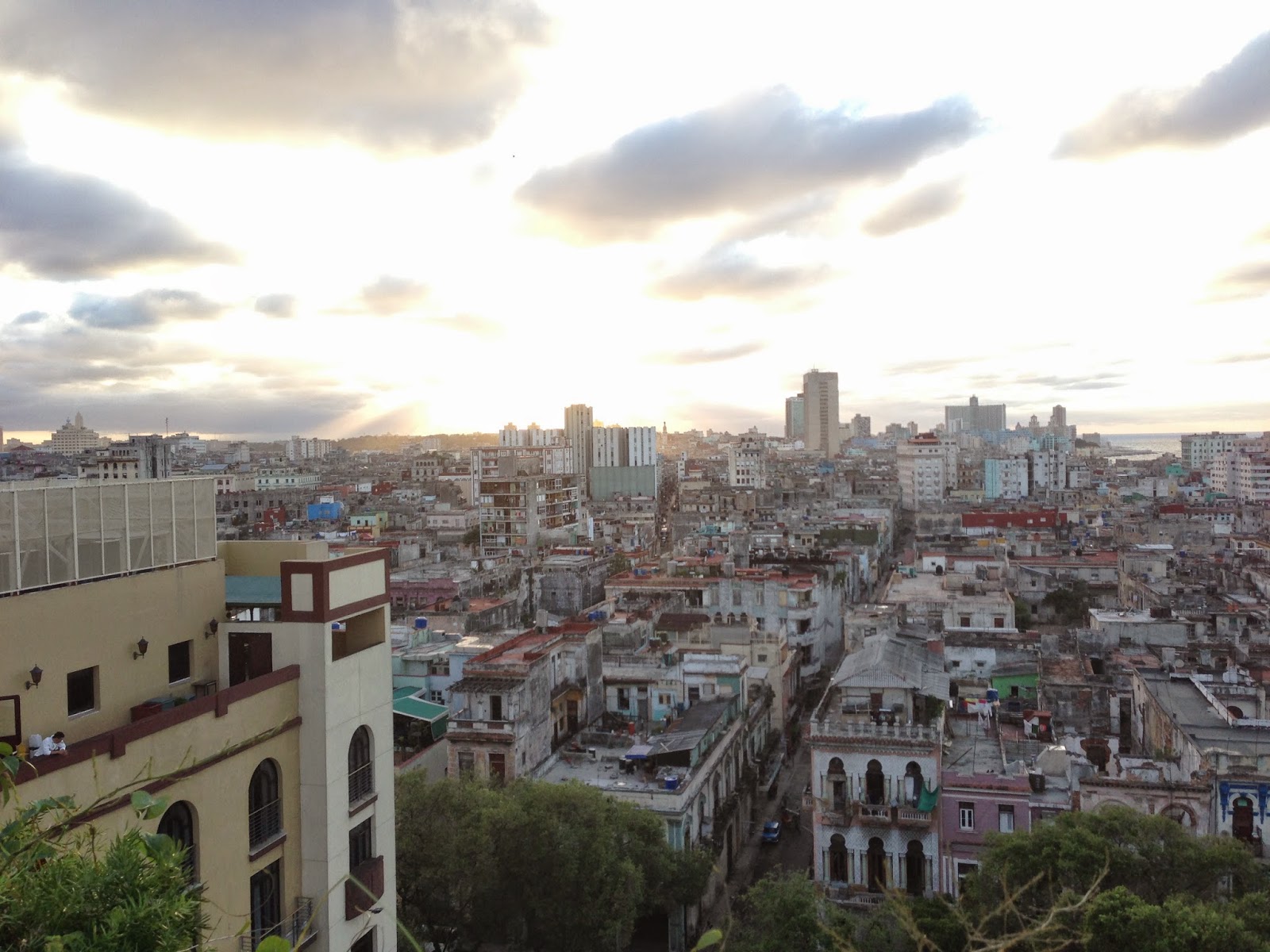
Cuba is what happens when a rapacious oligarchy clothed in the colours of The Revolution hiding behind the folds of it’s flag, inserts it’s rostrum into the body of it’s host for sustenance. It is shops, dusty, dimly lit; with goods, out of date: Hardly enough to fill a tenth of an aisle at your local drugstore. A vibrant people reduced to working several lines of pursuit for their livelihood while the wealth of this land (sugar, tobacco, sand, sea, metals, forest, oil, jazz, baseball) are expropriated for the few. It is the crumbling of structures put up by the Spanish and British with no sense of the preservation of a collective history. It is, perhaps, a purposeful forgetting in favour of the garishly large monuments to the Castro Revolution.
If the Cuban News Agency is to be believed, the Revolution is still fully in progress even in this year fifty-six since it’s inception. Sustaining a Revolution for almost 60 years is not an easy task. It calls for a bogey man worthy of David and Goliath. It calls for Uncle Sam, who serves the purpose well.
Blogger, Yoani Sanchez has written, “The wall serves not only to defend oneself… it allows one to control what happens within it,” reads Travels with Herodotus, and it’s painful that sixty years later it continues to be a reality in so many places.”
In contrast to the presence of the state apparatus: police, the military, informants, checkpoints, customs, currency controls, censorship, absolute media control, to name a few, is the dynamic inventiveness of the average Cuban. Forced to earn (officially) a pittance and spend a fortune for the staples of life, Cubans take to the underground economy which has been nudged, winked and fanned into existence by the Revolución.
An electrician-cum-laboratory technologist needs to drive a taxi to sustain a household of three. A doctor trained in Cuba with a reported salary of $20-30 US dollars per month must rush to the hotel rooms of bloated tourists in order to make ends meet. Women just barely out of their teens use the only resource valuable enough to warrant a living wage - their beauty. A beauty borne of more than 522 years of genetic blending, stirred by a passion seemingly present only in the tropic of Cuba.
So what’s to love about Cuba? The food (one): cheap and delicious; The drink (two) plentiful in its many and variegated forms; The bon vivant people (three); hellos involve a kiss on the right cheek (four), always; The weather (five): mostly warm but duck the hurricanes; History (six) and plenty of it, visible to the naked eye everywhere; the beauty of the people (seven); hardly any Internet (eight): trust me it’s a plus….leave your devices in the safe in your room; walking around at 1 a.m. with nary a fear (nine); lastly and (tenthly) the natural beauty of the countryside, lush, tropical, humid…in a word, paradisiacal. Snap, click, done.
Cuba is what happens when a rapacious oligarchy clothed in the colours of The Revolution hiding behind the folds of it’s flag, inserts it’s rostrum into the body of it’s host for sustenance. It is shops, dusty, dimly lit; with goods, out of date: Hardly enough to fill a tenth of an aisle at your local drugstore. A vibrant people reduced to working several lines of pursuit for their livelihood while the wealth of this land (sugar, tobacco, sand, sea, metals, forest, oil, jazz, baseball) are expropriated for the few. It is the crumbling of structures put up by the Spanish and British with no sense of the preservation of a collective history. It is, perhaps, a purposeful forgetting in favour of the garishly large monuments to the Castro Revolution.
If the Cuban News Agency is to be believed, the Revolution is still fully in progress even in this year fifty-six since it’s inception. Sustaining a Revolution for almost 60 years is not an easy task. It calls for a bogey man worthy of David and Goliath. It calls for Uncle Sam, who serves the purpose well.
Blogger, Yoani Sanchez has written, “The wall serves not only to defend oneself… it allows one to control what happens within it,” reads Travels with Herodotus, and it’s painful that sixty years later it continues to be a reality in so many places.”
In contrast to the presence of the state apparatus: police, the military, informants, checkpoints, customs, currency controls, censorship, absolute media control, to name a few, is the dynamic inventiveness of the average Cuban. Forced to earn (officially) a pittance and spend a fortune for the staples of life, Cubans take to the underground economy which has been nudged, winked and fanned into existence by the Revolución.
An electrician-cum-laboratory technologist needs to drive a taxi to sustain a household of three. A doctor trained in Cuba with a reported salary of $20-30 US dollars per month must rush to the hotel rooms of bloated tourists in order to make ends meet. Women just barely out of their teens use the only resource valuable enough to warrant a living wage - their beauty. A beauty borne of more than 522 years of genetic blending, stirred by a passion seemingly present only in the tropic of Cuba.
So what’s to love about Cuba? The food (one): cheap and delicious; The drink (two) plentiful in its many and variegated forms; The bon vivant people (three); hellos involve a kiss on the right cheek (four), always; The weather (five): mostly warm but duck the hurricanes; History (six) and plenty of it, visible to the naked eye everywhere; the beauty of the people (seven); hardly any Internet (eight): trust me it’s a plus….leave your devices in the safe in your room; walking around at 1 a.m. with nary a fear (nine); lastly and (tenthly) the natural beauty of the countryside, lush, tropical, humid…in a word, paradisiacal. Snap, click, done.
Tuesday, October 07, 2014
Better Late than Never
I have been keeping an ear open for the response to the unprecedented Ebola outbreak in West Africa and the, until recently, the flaccid response to the deaths in the region. Finally, it appears that the U.S. has recognized the scope of what is going on in the nations affected and how the infections in those nations could spread to many other regions of the world, including here in Canada.
And I wonder, again, if a similar outbreak had occurred in Switzerland or England whether it would have taken the U.S., Canada, and the other wealthier nations of the world, a full seven months to respond. It still seems to me that 3000 U.S. troops, along with the other nations that have responded is inadequate.
Here's a visual timeline from the Australian Broadcasting Corporation.
On September 16, 2014, a full six months after Guinea announced the outbreak, U.S. President Barack Obama announced a ramped up response to the outbreak which had by September 10th taken more than 2300 lives, with more than 4849 infected people reported. Both the Centre for Disease Control and the World Health Organization (WHO) have repeatedly said from the outset of the Ebola epidemic that all numbers are almost certainly under reported.
It appears that only after the arrival of Thomas Duncan in Dallas and his subsequent diagnosis with the Ebola virus did the U.S. and the West begin to take notice of the potential for the continuing spread of the virus beyond the initial 4 countries affected.
 Ken Isaacs, Vice President of program and government relations at Samaritan's Purse stated that the number of Ebola patients doubled between August and September 16, 2014. Predictions are for 100,000 people to be eventually affected.
The WHO had predicted in September that a total of 20,000 cases of Ebola could be expected by November, 2014. The Centre for Disease Control has made several projections: The worst case scenario is an incredible 1.4 million people by January, 2015. And the best case scenario predicts 550,000 cases by the end of January, 2015.
How the world has sat on the sidelines for so long with these kinds of numbers being put out by the CDC and WHO is beyond me. How is it possible to believe that this is not our problem if even half the numbers of cases predicted comes true is also hard to fathom. Some people will surely travel, undocumented from these regions to escape the virus. And some of these people migrating will certainly bring the virus to the shores of Europe.
Africa may seem far from North America but it is only days air travel away. Consider that the distance between Africa (Tangier, Morocco) and Europe (Taifa in Spain) is a mere 32 kms. The possibility of this outbreak going global is not too far fetched.
And I wonder, again, if a similar outbreak had occurred in Switzerland or England whether it would have taken the U.S., Canada, and the other wealthier nations of the world, a full seven months to respond. It still seems to me that 3000 U.S. troops, along with the other nations that have responded is inadequate.
Here's a visual timeline from the Australian Broadcasting Corporation.
On September 16, 2014, a full six months after Guinea announced the outbreak, U.S. President Barack Obama announced a ramped up response to the outbreak which had by September 10th taken more than 2300 lives, with more than 4849 infected people reported. Both the Centre for Disease Control and the World Health Organization (WHO) have repeatedly said from the outset of the Ebola epidemic that all numbers are almost certainly under reported.
It appears that only after the arrival of Thomas Duncan in Dallas and his subsequent diagnosis with the Ebola virus did the U.S. and the West begin to take notice of the potential for the continuing spread of the virus beyond the initial 4 countries affected.
Ken Isaacs, Vice President of program and government relations at Samaritan's Purse stated that the number of Ebola patients doubled between August and September 16, 2014. Predictions are for 100,000 people to be eventually affected.The WHO had predicted in September that a total of 20,000 cases of Ebola could be expected by November, 2014. The Centre for Disease Control has made several projections: The worst case scenario is an incredible 1.4 million people by January, 2015. And the best case scenario predicts 550,000 cases by the end of January, 2015.
How the world has sat on the sidelines for so long with these kinds of numbers being put out by the CDC and WHO is beyond me. How is it possible to believe that this is not our problem if even half the numbers of cases predicted comes true is also hard to fathom. Some people will surely travel, undocumented from these regions to escape the virus. And some of these people migrating will certainly bring the virus to the shores of Europe.
Africa may seem far from North America but it is only days air travel away. Consider that the distance between Africa (Tangier, Morocco) and Europe (Taifa in Spain) is a mere 32 kms. The possibility of this outbreak going global is not too far fetched.
Monday, September 08, 2014
Tepid Ebola Response Continues
The World Health Organization today announced that the "transmission of the Ebola virus...is increasing exponentially (in Liberia)." And even more concerning is the statement that "as soon as a new Ebola treatment facility is opened, it immediately fills to overflowing with patients, pointing to a large but previously invisible caseload."
What was a psychological barrier in my mind of 2000 deaths has been surpassed with hardly a ripple in various media. Ebola was not a trending topic on Google or Twitter or Facebook. What is trending is the news that Kate Middleton is experiencing morning sickness, news of Jack the Ripper's identity being confirmed and Serena Williams who won US Open, among others. Two thousand one hundred people have died thus far.
In case you're wondering, I know I was, the Ebola epidemic first appeared in March of this year. A total of 6 months. It has steadily widened in the number of countries it has affected and has claimed a lot of lives thus far. Besides the hardest hit three nations of Sierra Leone, Guinea and Liberia, Nigeria and Senegal have also been affected.
I admit that my opinion on this is not at all scientific but it would appear that the only time the Ebola epidemic in West Africa makes the news is when a health care worker from Europe or North America is infected. And then, inevitably, the focus goes from the news of the moment to the tragedy of the "good doctor" who risked his life to be in West Africa.
What gets lost is that the health worker in question is not just fighting a disease over there somewhere but is also protecting us over here by being over there. I'm not negating the charitable aspect or the personal sacrifices being made, but where is the concerted Western response? Because, lets admit, Africa does not have the capacity to deal with this health crisis on it's own. Sad to say but true.
At the beginning of the outbreak, Liberia had one doctor for every 100,000 people. That number continues to dwindle as native born health workers also become infected and die. In it's news release, WHO further states, "that the demands of the Ebola outbreak have completely outstripped the (Liberian) government’s and partners’ capacity to respond."
In only one of the 15 counties in Liberia a 1000 beds are needed but only 240 are available leading to people being turned away(!) from the facility. People then return to their homes to be cared for by family, who in turn, become infected.
The American response to the need for beds has been to announce that a specialized field hospital with a capacity of 25 beds would be flown to West Africa, while the British government has pledged a 50 bed facility. To be sure, these are not clinics meant to give flu shots and deal with paper cuts but are highly specialized and expensive undertakings. Nevertheless, too little is too little and one would hope not too late.
In a BBC report only three days ago, Dr Christopher Dye, the director of strategy in the office of the director general at the World Health Organization was quoted as saying, "If current trends persist we would be seeing not hundreds of cases per week, but thousands of cases per week and that is terribly disturbing."
What was a psychological barrier in my mind of 2000 deaths has been surpassed with hardly a ripple in various media. Ebola was not a trending topic on Google or Twitter or Facebook. What is trending is the news that Kate Middleton is experiencing morning sickness, news of Jack the Ripper's identity being confirmed and Serena Williams who won US Open, among others. Two thousand one hundred people have died thus far.
In case you're wondering, I know I was, the Ebola epidemic first appeared in March of this year. A total of 6 months. It has steadily widened in the number of countries it has affected and has claimed a lot of lives thus far. Besides the hardest hit three nations of Sierra Leone, Guinea and Liberia, Nigeria and Senegal have also been affected.
I admit that my opinion on this is not at all scientific but it would appear that the only time the Ebola epidemic in West Africa makes the news is when a health care worker from Europe or North America is infected. And then, inevitably, the focus goes from the news of the moment to the tragedy of the "good doctor" who risked his life to be in West Africa.
What gets lost is that the health worker in question is not just fighting a disease over there somewhere but is also protecting us over here by being over there. I'm not negating the charitable aspect or the personal sacrifices being made, but where is the concerted Western response? Because, lets admit, Africa does not have the capacity to deal with this health crisis on it's own. Sad to say but true.
At the beginning of the outbreak, Liberia had one doctor for every 100,000 people. That number continues to dwindle as native born health workers also become infected and die. In it's news release, WHO further states, "that the demands of the Ebola outbreak have completely outstripped the (Liberian) government’s and partners’ capacity to respond."
In only one of the 15 counties in Liberia a 1000 beds are needed but only 240 are available leading to people being turned away(!) from the facility. People then return to their homes to be cared for by family, who in turn, become infected.
The American response to the need for beds has been to announce that a specialized field hospital with a capacity of 25 beds would be flown to West Africa, while the British government has pledged a 50 bed facility. To be sure, these are not clinics meant to give flu shots and deal with paper cuts but are highly specialized and expensive undertakings. Nevertheless, too little is too little and one would hope not too late.
In a BBC report only three days ago, Dr Christopher Dye, the director of strategy in the office of the director general at the World Health Organization was quoted as saying, "If current trends persist we would be seeing not hundreds of cases per week, but thousands of cases per week and that is terribly disturbing."
Wednesday, August 20, 2014
Slum Dwellers Clash with Police in Liberia
The New York Times today reported the kind of thing you would only previously have seen in a Hollywood thriller.
A virulent virus outbreak in some Third World country is met with a weak response. Local officials are overwhelmed. A few hardy local and foreign doctors do their best to get the world's attention. The virus spreads despite the best initial efforts from rural areas to an urban centre. The poorest of poor are afflicted first. Read: Slum. The slum is Unsanitary, thickly populated and the slum dwellers are deeply distrustful with a dose of magical thinking. The army closes off the slum to stop the spread of the virus...residents of the virus react by trying to break out of the cordon, causing an already bad situation to get worse.
Unfortunately, this scenario is no longer fantastical it is a reality for West Point: A slum in the capital city of Monrovia, Liberia. The New York Times reports on this in a short piece here.
Dr. Joanne Liu, head of Doctors Without Borders, recently said, “No one yet has the full measure of the magnitude of this crisis.” Asked how much money is needed to squash the outbreak Dr. Liu has said, “I don’t know. We’re making history. We’re facing something we’ve never faced before.”
The New York Times has a good primer to common questions about the virus including the graphic below which you can find here.
A virulent virus outbreak in some Third World country is met with a weak response. Local officials are overwhelmed. A few hardy local and foreign doctors do their best to get the world's attention. The virus spreads despite the best initial efforts from rural areas to an urban centre. The poorest of poor are afflicted first. Read: Slum. The slum is Unsanitary, thickly populated and the slum dwellers are deeply distrustful with a dose of magical thinking. The army closes off the slum to stop the spread of the virus...residents of the virus react by trying to break out of the cordon, causing an already bad situation to get worse.
Unfortunately, this scenario is no longer fantastical it is a reality for West Point: A slum in the capital city of Monrovia, Liberia. The New York Times reports on this in a short piece here.
Dr. Joanne Liu, head of Doctors Without Borders, recently said, “No one yet has the full measure of the magnitude of this crisis.” Asked how much money is needed to squash the outbreak Dr. Liu has said, “I don’t know. We’re making history. We’re facing something we’ve never faced before.”
The New York Times has a good primer to common questions about the virus including the graphic below which you can find here.
 |
| Click on the graphic to see a larger image. |
Sunday, August 17, 2014
Ebola Virus History
Ebola first appeared in 1976 in 2 simultaneous outbreaks, in Nzara, Sudan, and in Yambuku, Democratic Republic of Congo. The latter was in a village situated near the Ebola River, from which the disease takes its name.
Genus Ebolavirus is 1 of 3 members of the Filoviridae family (filovirus), along with genus Marburgvirus and genus Cuevavirus. Genus Ebolavirus comprises 5 distinct species:
- Bundibugyo ebolavirus (BDBV)
- Zaire ebolavirus (EBOV)
- Reston ebolavirus (RESTV)
- Sudan ebolavirus (SUDV)
- Taï Forest ebolavirus (TAFV).
(Follow the above link for the full article on the history of Ebola outbreaks on the WHO's website).
Saturday, August 16, 2014

Monday, July 28, 2014


Computer, show me the way to Balsam Lake!
Looking forward to a couple of days of camping at Balsam Lake Provincial Park. We've never been to Balsam Lake but the inter-web tells me it is a family friendly camp with a beach, fishing, canoeing and hiking trails. More than enough to do for the 4 days we will be there.
Saturday, July 26, 2014

Friday, July 25, 2014
“Vacation Sex”: A Poem by Dorianne Laux
We’ve been at it all summer, from the Canadian border
to the edge of Mexico, just barely keeping it American
but doing okay just the same, in hotels under overpasses
or rooms next to ice machines, friends’ fold-out couches,
in-laws’ guest quarters—wallpaper and bedspreads festooned
with nautical rigging, tiny life rings and coiled tow ropes—
to the edge of Mexico, just barely keeping it American
but doing okay just the same, in hotels under overpasses
or rooms next to ice machines, friends’ fold-out couches,
in-laws’ guest quarters—wallpaper and bedspreads festooned
with nautical rigging, tiny life rings and coiled tow ropes—
even one night in the car, the plush backseat not plush
enough, the door handle giving me an impromptu
sacro-cranial chiropractic adjustment, the underside
of the front seat strafing the perfect arches of his feet.
And one long glorious night in a cabin tucked in the woods
where our crooning and whooping started the coyotes
enough, the door handle giving me an impromptu
sacro-cranial chiropractic adjustment, the underside
of the front seat strafing the perfect arches of his feet.
And one long glorious night in a cabin tucked in the woods
where our crooning and whooping started the coyotes
singing. But the best was when we got home, our luggage
cuddled in the vestibule—really just a hallway
but because we were home it seemed like a vestibule—
and we threw off our vestments, which were really
just our clothes but they seemed like garments, like raiment,
like habits because we felt sorely religious, dropping them
cuddled in the vestibule—really just a hallway
but because we were home it seemed like a vestibule—
and we threw off our vestments, which were really
just our clothes but they seemed like garments, like raiment,
like habits because we felt sorely religious, dropping them
one by one on the stairs: white shirts, black bra, blue jeans,
red socks, then stood naked in our own bedroom, our bed
with its drab spread, our pillows that smelled like us:
a little shampoo-y, maybe a little like myrrh, the gooseberry
candle we light sometimes when we’re in the mood for mood,
our own music and books and cap off the toothpaste and cat
red socks, then stood naked in our own bedroom, our bed
with its drab spread, our pillows that smelled like us:
a little shampoo-y, maybe a little like myrrh, the gooseberry
candle we light sometimes when we’re in the mood for mood,
our own music and books and cap off the toothpaste and cat
on the window seat. Our window looks over a parking lot—
a dental group—and at night we can hear the cars whisper
past the 24-hour Albertson’s where the homeless couple
buys their bag of wine before they walk across the street
to sit on the dentist’s bench under a tree and swap it
and guzzle it and argue loudly until we all fall asleep.
a dental group—and at night we can hear the cars whisper
past the 24-hour Albertson’s where the homeless couple
buys their bag of wine before they walk across the street
to sit on the dentist’s bench under a tree and swap it
and guzzle it and argue loudly until we all fall asleep.
Wednesday, July 09, 2014
The Source of Frustration
Letter I just sent off to the President of The Source, Charles Brown:
I will not be shopping at The Source ever again.
Hello,
Regarding:
The Source, Store #55113
Morningside Crossing
4525 Kingston Rd Unit #H7
Toronto ON, M1E 2P1
(416) 282-4406
I went to The Source store (see above) near my home on June 8, 2014, to exchange the batteries on my cordless handsets for one replacement (payable by me as it was an original battery) and two replacements (which I thought were covered by a warranty sold to me by this same store a year or two ago.) At the time that I bought the warranty, I bought two batteries and was told that the batteries were easily identifiable as being from The Source and that my warranty information would be kept on the stores database. I was told that coming in for replacement batteries would not be a problem even without a receipt.
I walked in to the store with my kids (9 and 13 years old) for what I thought would be a 10 minute trip to the store. The trip to this store, for the exclusive purpose of just exchanging my batteries, took 35 minutes.
I explained to the sale person (Faraque) that I thought my batteries were under a warranty and that I was looking to replace my dead batteries. From the start, Faraque told me that I should simply get a new cordless phone set from the store. That getting batteries would be too expensive. I thought that he did not understand that two of my handset batteries were covered under a warranty and since the batteries cost about $25 each that it made more sense for me to just buy one set of batteries and replace the other two as per my warranty. I explained this to him again.
When we returned to the sales counter, Faraque checked my battery type and said that this store did not have any batteries of the type I needed but that I could go to two other nearby Source stores to get my replacement batteries. I was surprised that The Source did not have even one of the three replacements I needed. So I went to the shelf with the batteries and managed to find one of the type of batteries I needed. As I continued my search, Faraque insisted that I stop looking for more of the same batteries. He said that he missed seeing the one battery that was in the store and his computer was not showing any other stock in the store. Just the one I had found.
As it turned out, Faraque was right. Unable to find another battery, I went back to the counter. Faraque then asked me for my contact information for the second time. I gave him this information and then after a long search told me that only the batteries for one handset were covered under a warranty but not from the second handset. I told the sales person how he knew, without me having a receipt, that the battery inside the one handset contained a battery previously bought at the source. He said that the batteries sold at the The Source have numbers unique to The Source. I wondered than how my two batteries bought at the same time a few years ago were not equally covered? Why would a customer put one set of batteries under warranty and not the other? And since he recognized that both batteries that I was claiming were under warranty, were from The Source, could he not make an exception? I asked him to check his records to see that I was indeed a loyal customer of this particular location? He said he had a charger of some sort which I had, in the past, also put under warranty.
Faraque insisted that he could replace one battery under the warranty but offered me no other options. He did not offer to call nearby stores, or check to see when a shipment of this particular battery might be coming in or offer any other alternatives that might have been open to him. Since I did not have a receipt and I was relying on The Source to keep track of my warranty purchase, I had to admit that there was not much I could do to pursue the warranty on the second battery. When I asked what Faraque thought I should do to replace batteries for my other two handsets, he suggested going to the other Source stores or buying similar batteries from some electronics store.
I finally asked this sales person to print a receipt of some sort showing that I had requested and gotten a replacement battery from the store under my warranty. The printing of any kind of document, I said to him, would be fine: such as my warranty or a receipt. Faraque said that since they were using a new computer system, the printer was not working properly. At this point I became very upset, but not abusive. I wondered how a store that specializes in selling electronics could not get their cash register to send a print command to their printer. Eventually, after a 5-10 minute delay, a document was printed out.
Once the document which was printed was brought from the back of the store, Faraque handed me a plain piece of paper on which he had handwritten the identifying numbers of my battery type. I insisted that I get the paper that he had actually printed out that carried identifying numbers on it for my records as I was going to be calling the customer complaints line due to the terrible customer service I had gotten at this store. Faraque then told me that the print out which he had produced was for store use only and was private. Then, Faraque, challenged me by saying: ‘why do you want to call the customer complaint line?’ So I went over the facts of my visit thus far for him:
1. I came in to replace my batteries 30 minutes ago
2. He asked me to buy an entire cordless phone set
3. Insisted he didn’t have the batteries I needed
4. When I found the batteries I needed in the store
5. He insisted that there was just the one and I should go elsewhere for my other batteries
6. Then he found my warranty but only for one set of batteries
7. Then he couldn’t print a receipt or warranty information for me
8. When he did print warranty information for me….he couldn’t give it to me because it was private
9. Then he tried to simply give me a handwritten piece of paper
10. And was now challenging my idea of calling a customer complaints line like there was nothing wrong at all with all our interactions.
At this point, Faraque finally decided to hand me the print out from the printer. Since there were no phone numbers on the print out I had been given, I asked for an 1-800 customer service number from him. Faraque began by giving me a 705 area code number. I protested and asked if there was no one number that a customer could call to lodge a complaint about service. Faraque said that he was not aware of any other numbers and that the 705 number was for the head office for The Source.
After about 35 minutes of trying to get a helpful answer from this employee, I finally headed out the door (with my kids in tow) without a word from this sales associate or the other two sales people who were in the store.
I am deeply disappointed that someone who works at a well known chain store such as The Source would be so cavalier with the loyalty that I have shown, especially to this store, over the years. I assure you that I do not plan on going to this store ever again
I will not be shopping at The Source ever again.
Saturday, July 05, 2014
Home again and then some
I returned home on June 30th and have spent all this time recovering from the nightmare of symptoms I brought home with me.
On July 1st I ended up visiting the emergency department of Centennary Hospital to complain about my extremely painful headache and neck pain. Symptoms of my stomach flu had abated. Both the fever, listlessness, headaches, photophobia, sensitivity to noise and general achiness had combined to give the impression that there was more going on with me than just an exacerbation of a migraine and a stomach bug. Meningitis was the first guess for the doctors in England. A CT scan and then a lumbar puncture prove this to be wrong.
What I came home with, then, was a massive migraine and the subsequent pain of having neck, shoulder and cranial muscles which had gotten a work out that they could not recover from. I needed pain killers to help me get through the day and and muscle relaxants to help my muscles revert to their normal state.
The emergency room doctor gave me migraine medications and then, when that didn't work, morphine. I was sent home with a referral to a neurologist and narcotic pain killers.
I saw the neurologist the next day: a stroke of luck as they had cancellation. The neurologist, a weird bird who made little to no eye contact and misread my information thinking I had had meningitis, prescribed Percocets (40 no less) for the pain. And a requisition for an MRI.
The following day, not trusting entirely in the neurologists 3 minute assessment, I followed up with my GP. The GP, whom I totally trust, told me to stop the Percocets and put me on steroidal meds to decrease my muscle inflammation and Pregabalin to reduce my sensitivity to pain. The pregabalin, from what I can gather, coats nerve cells and reduces their ability to communicate with each other. In my case, I think I had become oversensitive to pain or even the anticipation of the pain I would experience. Not sure if this make scientific sense...but it's my sense of what was going on: I needed my muscles to relax enough to recover, I needed to reduce muscle inflammation and the GP rightly added, something to take the edge off.
So it's been two days of being on this regimen of steroid and neuropathic analgesics to set my back on even keel. I have never, ever experienced anything like this. I did not even know that I had more than an occasional migraine (once every six months).
I have spent most of my days back in Toronto lying around the house, hiding from sudden changes in light and walking gingerly from one spot to another. I have, thankfully, gotten better each day and am contemplating going out to do some gardening tomorrow.
My sister in England, in the meantime, has been moved to her hometown's hospital as was her husband much earlier. They are both reported to be doing well. She is out of ICU and able to communicate fairly well. She still has a tracheostomy in place and so cannot talk. Otherwise making slow, measurable progress.
And that is what I have today in the way of updates.
On July 1st I ended up visiting the emergency department of Centennary Hospital to complain about my extremely painful headache and neck pain. Symptoms of my stomach flu had abated. Both the fever, listlessness, headaches, photophobia, sensitivity to noise and general achiness had combined to give the impression that there was more going on with me than just an exacerbation of a migraine and a stomach bug. Meningitis was the first guess for the doctors in England. A CT scan and then a lumbar puncture prove this to be wrong.
What I came home with, then, was a massive migraine and the subsequent pain of having neck, shoulder and cranial muscles which had gotten a work out that they could not recover from. I needed pain killers to help me get through the day and and muscle relaxants to help my muscles revert to their normal state.
The emergency room doctor gave me migraine medications and then, when that didn't work, morphine. I was sent home with a referral to a neurologist and narcotic pain killers.
I saw the neurologist the next day: a stroke of luck as they had cancellation. The neurologist, a weird bird who made little to no eye contact and misread my information thinking I had had meningitis, prescribed Percocets (40 no less) for the pain. And a requisition for an MRI.
The following day, not trusting entirely in the neurologists 3 minute assessment, I followed up with my GP. The GP, whom I totally trust, told me to stop the Percocets and put me on steroidal meds to decrease my muscle inflammation and Pregabalin to reduce my sensitivity to pain. The pregabalin, from what I can gather, coats nerve cells and reduces their ability to communicate with each other. In my case, I think I had become oversensitive to pain or even the anticipation of the pain I would experience. Not sure if this make scientific sense...but it's my sense of what was going on: I needed my muscles to relax enough to recover, I needed to reduce muscle inflammation and the GP rightly added, something to take the edge off.
So it's been two days of being on this regimen of steroid and neuropathic analgesics to set my back on even keel. I have never, ever experienced anything like this. I did not even know that I had more than an occasional migraine (once every six months).
I have spent most of my days back in Toronto lying around the house, hiding from sudden changes in light and walking gingerly from one spot to another. I have, thankfully, gotten better each day and am contemplating going out to do some gardening tomorrow.
My sister in England, in the meantime, has been moved to her hometown's hospital as was her husband much earlier. They are both reported to be doing well. She is out of ICU and able to communicate fairly well. She still has a tracheostomy in place and so cannot talk. Otherwise making slow, measurable progress.
And that is what I have today in the way of updates.
Subscribe to:
Posts (Atom)